As a key activity in an IT services company’s Lead-to-Cash process, responding to a tender remains one of the most critical stages of the sales cycle… and one of the most time-consuming.
Analysing sometimes complex tender documents, gaining a detailed understanding of client expectations, structuring responses, gathering references and carrying out successive reviews all require rigour, a systematic approach and a significant amount of time. The pre-sales phase is therefore particularly demanding, in terms of both content and form.
At TeamWork, this realisation was the starting point for AI Studio. The aim was not simply to “do AI”, but to create a shared framework for practical, useful and controlled applications to optimise our operational model. An internal platform designed to support teams in their day-to-day work, develop skills and highlight real-world use cases that are understandable and transferable to our clients. AI Studio also helps to avoid isolated initiatives by maintaining control over data and practices.
From the outset, AI Studio was designed to operate within a secure and controlled environment: data remains confined to TeamWork’s controlled environments (security and costs) and is never used to train models.
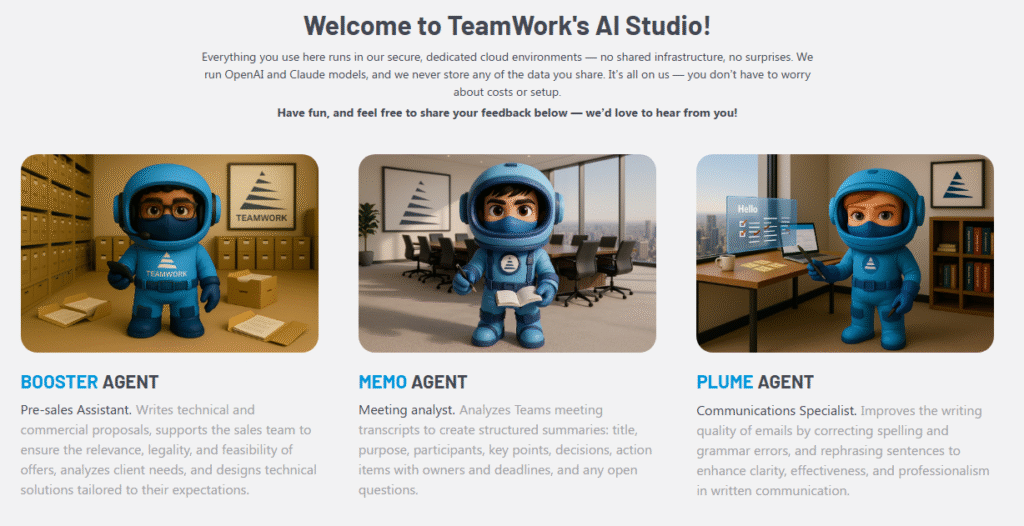
AI Studio is now built around three rapidly developed and scalable tools:
- Memo, for analysing and organising meeting minutes, with dedicated templates for: design workshops, client introductory meetings, etc.
- Plume, to improve the quality of professional writing.
- Booster, designed to support sales and pre-sales teams in preparing responses to tenders.
Booster, a pre-sales tool designed for teams
In a context where the pre-tender process needs to move quickly without compromising on quality, Booster acts as a valuable assistant. It helps analyse tender documents, identify key requirements, structure responses and finalise deliverables. It also plays a role in the proofreading stage to check that responses are complete, consistent and clear.
The aim is never to replace human expertise. Booster supports the work of teams, standardises practices and provides a structured framework. Teams remain fully responsible for the content, compliance and relevance of the responses provided to customers. AI acts here as a support tool, ensuring quality and reliability.
Initial impacts of AI in pre-sales
Initial feedback from the Sales and Pre-Sales teams indicates tangible, measurable and realistic improvements. These relate to three key areas: efficiency, quality and relevance.
- Time savings: Booster delivers an estimated time saving of around 20% across the entire process, from the initial Go/No-Go decision through to the structuring and review of the final response. This saving is most evident in the preparation of the questions and answers. It also applies to the compilation of administrative elements, in particular the summary of requirements, the documents to be attached and the structuring of the application. Finally, it covers the identification of relevant references and the overall formatting of the response.
- Ensuring the accuracy of responses: The platform helps identify gaps in relation to the client’s requirements. It can also highlight shortcomings in the consultation itself (e.g. a lack of clarity regarding compliance with standards such as GxP, ISO, etc.). This verification stage helps to produce complete, consistent and compliant dossiers. It also significantly reduces the risk of omissions.
- Standardisation of practices and relevance: Booster helps to structure responses. It enables the identification of TW’s unique selling points and the standardisation of templates. It does not automate the content and is no substitute for customer knowledge. The tool is not designed to personalise to the extreme, but to improve reliability. Its impact is measured by the conversion rate of applications, estimated at between 5 and 10 per cent.
These applications demonstrate a pragmatic and efficient approach. AI does not write on behalf of teams. It saves them time, ensures the quality of deliverables and guarantees the accuracy of responses.
Managed and protected data
AI Studio is based on a fundamental principle: control over data and costs. Unlike in mainstream applications, the information processed within AI Studio remains strictly confined to TeamWork’s controlled infrastructure and environments. It is never used to train models, nor is it exposed to ungoverned external platforms. This approach guarantees a high level of confidentiality, control and compliance. It is consistent with our internal security requirements and with our clients’ expectations, particularly regarding sensitive matters relating to commercial, contractual or strategic data.
Beyond internal use, this approach lies at the heart of the support TeamWork offers its clients. The AI Studio embodies a firm belief: AI is only valuable if it is integrated into a secure, governed and controlled environment. This is exactly what we are implementing as part of our Digital Factory. Business-specific AI assistants designed based on real-world use cases. They are integrated into existing environments and deployed within controlled architectures. Clients retain control over their data, rules and models.
For businesses, the challenge is therefore not simply to adopt AI, but to do so without compromising on security, compliance and trust. Useful, responsible and sustainable AI always starts with well-managed data.