SAP S/4HANA Condition Contract Management (CCM) manages trade agreements such as rebates, promotions, tenders, commissions, and supplier or customer agreements as a single connected object linked to pricing, accruals, and financial settlement.
TeamWork designs and delivers SAP S/4HANA CCM solutions for organizations replacing legacy rebate processes or running high-volume, multi-country contract migrations.
A “Buy One, Get One Free” promotion looks simple enough to the customer. Behind it sits a formal agreement between a brand and a retailer, with eligible products, promotional periods, expected volumes, funding, rebate calculation, accruals, and settlement terms, all of it auditable.
CCM is what makes that possible inside SAP. But getting real value out of it depends less on the software and more on who implements it: an implementation partner who understands the commercial agreement itself, not just the configuration screens.
WHY ORGANIZATIONS BRING IN TEAMWORK FOR CCM
Our CCM experts have built dedicated delivery experience across multi-country, high-volume programs, the kind where legacy processes break down under real transaction volume and a generic implementation approach isn’t enough.
The clearest proof of that experience is a program our team delivered across 7 countries: more than 4,000 contracts in Latin America and more than 10,000 in the United States during the migration cutover alone, with the system now processing thousands of new contracts every day.
The contract-loading approach already in place had been built around European market logic, and the US and Latin American markets turned out to be complex enough, and structurally different enough, that it couldn’t keep up, putting the client’s go-live timeline at real risk.
Running it as a parallel mini-project, our consultants helped to deliver a new contract-loading solution and a controlled migration strategy, then ran it through mock loads, technical testing, business validation, training, cutover prep, and go-live support.
RESULT
A large share of the manual workload disappeared. Much of that information used to live scattered across Excel files; now it all runs inside the system.
That program is where a lesson our team now applies to every CCM engagement came from: mass contract creation isn’t a secondary data task, it’s a central delivery workstream, and treating it as anything less is how timelines slip.
Our consultants now size migration effort into the plan from day one, instead of discovering the real scope halfway through design.
HOW TEAMWORK APPROACHES A CCM IMPLEMENTATION
Our approach comes directly out of that kind of field experience, not a theoretical playbook. Five practices apply on every engagement:
| SCOPE THE SOLUTION EARLY | Before the design gets locked in, our consultants work through the business and technical questions that shape contract volume, complexity, integration requirements, and migration effort, so the client’s timeline is built on something real rather than a template estimate. |
| INVOLVE THE FULL VALUE CHAIN. | Commercial, Sales, Finance, Controlling, Pricing, Master Data, Reporting, IT, local markets, and operational support all get brought into the same contract lifecycle, so the solution reflects how the business actually runs, not just the SAP piece of it. |
| TREAT MIGRATION AS A CORE WORKSTREAM | Not a data cleanup task. Mapping, preparing, validating, loading, and reconciling contracts, plus the tooling for mass creation after go-live, all get planned for up front. |
| DESIGN REPORTING ALONGSIDE THE SOLUTION | Our team includes operational and financial visibility in the implementation scope rather than addressing it only after deployment. |
| BUILD GOVERNANCE INTO DELIVERY | Approval requirements, responsibilities, authorizations, and audit expectations are incorporated into the design and testing strategy. |
It’s this combination, cross-functional delivery discipline plus hands-on migration experience at real volume, that our team brings to every CCM engagement, and it’s what separates a working solution from a technically correct one that the business can’t actually run on.
WHAT CCM CHANGES FOR THE BUSINESS
In SAP ECC, trade agreements were usually spread across rebate agreements, condition records, spreadsheets, and separate financial processes that didn’t always talk to each other. CCM pulls that into one connected object, and our job is making that object match how the client’s business actually operates.
THE AGREEMENT BECOMES A CENTRAL SAP OBJECT
A condition contract in S/4HANA can represent rebate agreements, purchasing and sales agreements, or retroactive agreements settled after the fact. It holds the partners, products, conditions, business-volume rules, accrual requirements, and settlement terms in one structure. Our consultants translate a client’s real commercial agreements into that structure rather than forcing the business into a generic template.
A SIMPLE BOGO EXAMPLE
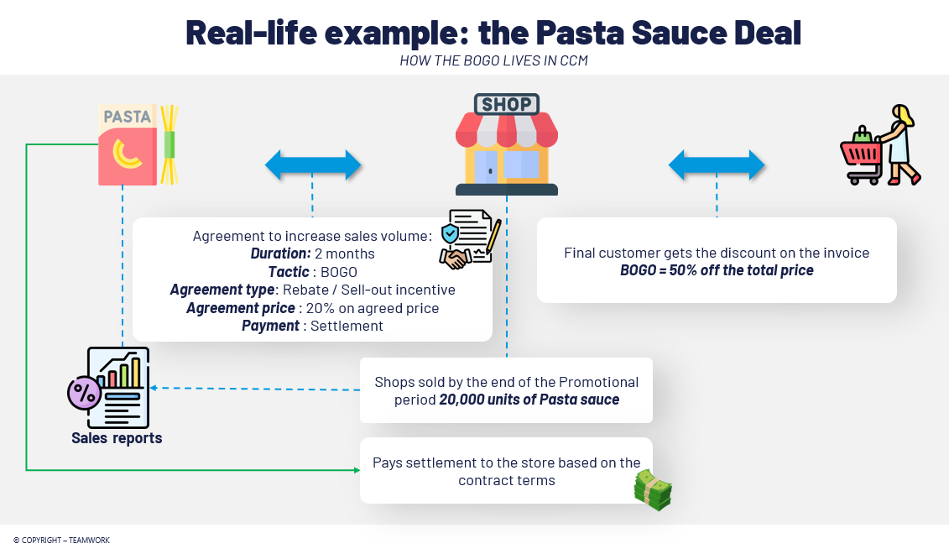
Consider a brand that agrees to fund a two-month “Buy One, Get One Free” promotion with a retailer. The consumer gets the deal at the register, but the brand’s reimbursement to the retailer runs on a separate commercial agreement entirely.
In CCM, the condition contract can define:
- The retailer and eligible products
- The promotion period
- The agreed rebate or funding rate
- The transactions that count toward the agreement
- The accrual and settlement schedule
As eligible sales happen, SAP determines the relevant business volume, calculates the amount owed, posts the required accruals, and later generates the settlement documents automatically.
Our SAP consultants focus on making sure that configuration reflects the real commercial arrangement, because an incorrect volume rule, pricing basis, or settlement condition can directly affect the financial result, not just the SAP screen.
In practical terms, this is what CCM is doing in the BOGO example above: it tracks eligibility, calculates what’s owed as sales happen, and settles it automatically, instead of someone manually cross-referencing sales reports, contract terms, and accrual spreadsheets. Done well, that typically means faster settlement cycles and a lot less manual reconciliation between Commercial and Finance.
WHERE CCM IMPLEMENTATIONS TEND TO GO WRONG, AND HOW TEAMWORK GETS AHEAD OF IT
CCM is powerful, but it’s easy to underestimate. Based on field experience, four areas create most of the project risk.
SPECIALIZED EXPERTISE
CCM isn’t just SD pricing and rebate processing. It touches Commercial, Sales, Finance, Controlling, Master Data, Reporting, and Settlement all at once. Our SAP consultants understand the full agreement lifecycle, not just isolated configuration.
CONTRACT MIGRATION AND MASS CREATION
Legacy rebate agreements rarely map cleanly onto the multilayered structure of an S/4HANA condition contract. TeamWork treats migration and high-volume contract creation as its own workstream, with field-level mapping, validation, mass-load tooling, reconciliation against legacy balances, and a cutover plan built around it from the start.
REPORTING AND BUSINESS VISIBILITY
The data usually exists somewhere in SAP, but the business view stays fragmented across applications and reports. Our consultants identify reporting requirements during solution design, so Commercial and Finance can monitor contract performance without rebuilding the picture in Excel.
GOVERNANCE AFTER GO-LIVE
Changes to active contracts affect pricing, accruals, rebate liabilities, and settlement amounts. Our team builds approval requirements, authorizations, segregation of duties, and auditability into the implementation itself, not as an addition after an audit finding.
FORESIGHT BEATS FIREFIGHTING
SAP S/4HANA CCM provides a powerful foundation for connecting trade agreements with transactional and financial processes.
Its value, however, depends on how well the solution is scoped, designed, migrated, governed, and supported.
Our CCM experts combine SAP knowledge, business-process understanding, migration experience, and lessons learned from demanding global programs to help organizations implement the solution with greater visibility and control.
TAKE THE NEXT STEP

SUCESS BUSINESS CASE
TeamWork US reinforced its position as a trusted partner by extending the momentum from successful deliveries in North America into a new transformation chapter for our client’s LATAM operations. Building on an established collaboration model, TeamWork helped our client navigate a complex regional program through strong upfront planning, cross-functional coordination, and disciplined execution..

CONTACT US
If your CCM scope involves a multi-country rollout, high contract volumes, or a legacy rebate migration, this is the kind of work TeamWork has done at scale.
Reach out to TeamWork to talk through your SAP S/4HANA CCM strategy, implementation, migration, reporting, and governance needs.
FREQUENTLY ASKED QUESTIONS
| What is SAP S/4HANA CCM used for? |
| SAP S/4HANA CCM, part of SAP Settlement Management, manages trade agreements, such as rebates, promotions, tenders, commissions, and supplier or customer agreements, connecting them to pricing, business-volume determination, accruals, and financial settlement in one SAP object. |
| How is CCM different from rebate management in SAP ECC? |
| In ECC, trade agreements were typically split across rebate agreements, condition records, spreadsheets, and separate financial processes. CCM consolidates them into a single condition contract with connected pricing, accrual, and settlement processes. |
| What makes CCM implementations difficult? |
| The main risk areas are cross-functional design complexity, migrating legacy rebate agreements into the CCM structure at volume, building adequate reporting for Commercial and Finance, and governing changes to active contracts after go-live. |
| Who can help implement SAP CCM? |
| TeamWork implements SAP S/4HANA CCM for organizations replacing legacy rebate processes, planning high-volume or multi-country contract migrations, or improving an existing CCM solution. |