TeamWork US reinforced its position as a trusted partner by extending the momentum from successful deliveries in North America into a new transformation chapter for our client’s LATAM operations. Building on an established collaboration model, TeamWork helped our client navigate a complex regional program through strong upfront planning, cross-functional coordination, and disciplined execution..
The LATAM initiative was guided by a clear mission: enable a multi-country transformation while maintaining delivery control under demanding timelines. Beyond achieving project milestones, the program focused on aligning business, operations, and IT stakeholders across LATAM, the US, Europe, and Asia. By creating a shared vision via a unified roadmap, structured governance, and coordinated ways of working, the project improved decision-making speed, increased agility, and strengthened collaboration, ensuring delivery remained tightly connected to our client’s strategic objectives and positioning the LATAM program as a reference success story.
SUMMARY
| 1. Executive Summary |
| 2. Business Need & Scope of Work |
| 3. Delivery Approach and Solutions |
| 4. Risk Assessment & Mitigation |
| 5. Timeline & Deployment Phase |
| 6. Results & Business Benefits |
01. EXECUTIVE SUMMARY
Our client’s LATAM project represented a high-impact regional initiative requiring strong governance, detailed planning, and coordinated execution across multiple teams and business functions. The environment was complex: multiple stakeholders, strict timelines, operational dependencies, and the need to maintain business continuity while preparing for change.
This success story is rooted in the ability to combine strategic vision with practical delivery. TeamWork supported the client by bringing structure to complexity, aligning teams around common priorities, and transforming potential delivery risks into manageable workstreams. Through disciplined planning, transparent communication, and close collaboration, the project progressed with clarity and purpose.
More than a project delivery effort, this initiative became a demonstration of how the right governance, the right people, and the right timing can turn a challenging transformation into a successful business outcome.
PROJECT SCOPE
The program covered a broad, cross-functional scope and deployed the solution across 11 end-to-end core company processes, ensuring full operational coverage from planning through execution, finance, and governance.
- Forecast to Plan (F2P)
- Procure to Receive (P2R)
- Plan to Manufacture (P2M)
- Project to Decommissioned (P2D)
- Warehouse Management (WHM)
- Order to Serve (O2S)
- Supply Chain Integration (SCI), including ICO and EM
- Manage Quality (MQU)
- Manage Finance (MFI), covering A2R, Cl2C, P2P, and Treasury
- Master Data Management (MDM)
- Controlling (CTR)
In addition, the project incorporated the Treasury Core Model (TCM) to support standardized treasury capabilities and alignment with the broader financial operating model.
CHALLENGES
The program was delivered in a highly complex environment shaped by regulatory, operational, and technology constraints across multiple countries. The main challenges included:
- Industry-specific critical calendar: Key commercial and operational dates in one of the client’s core business divisions had to be protected throughout the project lifecycle, influencing the initial roadmap and all subsequent schedule adjustments.
- Country-specific e-invoicing landscape: Multiple e-invoicing solutions needed to be assessed and integrated depending on local market requirements.
- Local legal and tax authority compliance: Each country imposed distinct legal and tax obligations that required careful design and validation.
- Concurrent initiatives: The project was executed alongside multiple local and global programs, requiring continuous coordination and dependency management.
- Parallel legal restructuring: Ongoing legal restructuring introduced additional complexity in governance, design decisions, and timing.
- High number of legal entities: The volume of legal entities increased the effort for master data, finance, compliance, and operational processes.
- Dual market segments per country: The solution had to support two distinct business divisions, each with specific operational needs.
- Large digital ecosystem: The landscape included 60+ partner applications, driving significant integration and end-to-end testing requirements.
02. BUSINESS NEED & SCOPE OF WORK
The project was shaped by an ambitious scope of work and a demanding timeline. Our client required a delivery model capable of supporting regional business needs while maintaining control over execution, quality, and risk. The challenge was not only technical; it was also organizational. Multiple departments across 7 different markets had to move in parallel, decisions had to be made quickly, and dependencies had to be managed carefully to avoid delays or disruptions.
The need was therefore clear: a structured, agile, and collaborative approach that could connect strategy to execution while keeping the client’s objectives at the center of every decision.
As a trusted partner, TeamWork responded to this challenge by combining resources from its different pillars across two main regions: the USA and Colombia. The SAP teams from the TWUS and TWCO pillars rose to the challenge. These teams included:
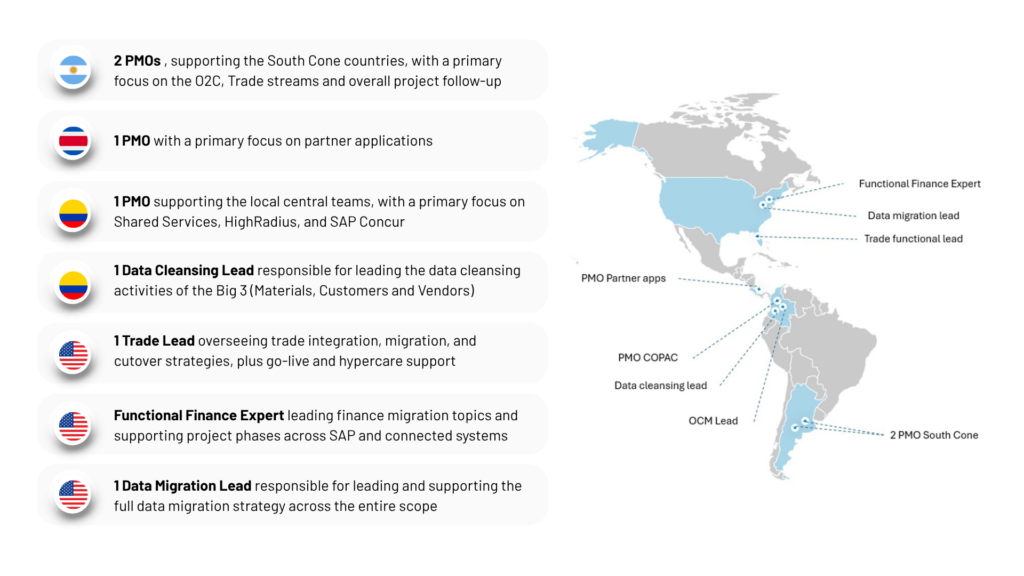
From the TeamWork Tomorrow pillar, the OCM Lead led the full change management strategy in alignment with our client’s global strategy, while ensuring that local requirements and specifications were considered. This enabled seamless communication across the different phases of the project and supported the training of several hundred end users across more than ten countries.
03. DELIVERY APPROACH AND SOLUTIONS
To deliver the project successfully, a strong delivery framework was required, combining planning discipline, technical coordination, and business engagement.
WHAT WAS NEEDED TO DELIVER THE PROJECT
- Clear governance and decision-making channels
- Detailed planning and sequencing of activities
- Cross-functional coordination between business and technical teams
- Continuous monitoring of dependencies, risks, and critical actions
- Readiness management for cutover, deployment, and stabilization
- Re-use of the developments and specificities of localization from a previous project that apply to the current scope
- Prioritize team selection with experience in previous implementations
- Retrofit the configurations and developments made in previous projects
- Re-use the established core model from prior deployments
- Share live experiences and apply the best practices and lessons learned from previous projects across North America and Europe, and from projects implemented in parallel in the region: expert team in project design and backfills in operation, anticipate roadblocks, mitigate risks before they rise, reassess the global strategy to align it with local requirements
WHO WAS NEEDED AND HOW LONG FOR
The project relied on a multidisciplinary team over the full project lifecycle, from planning through stabilization. This included project management, functional experts, technical consultants, business stakeholders, testing teams, cutover leads, and support teams. Regional coordination was especially important to ensure consistency across markets while respecting local operational realities.
- Typical involvement covered:
- Project leadership and PMO throughout the project lifecycle
- OCM lead ensuring the change management strategy is aligned with both the client’s global vision and the local requirements
- Functional and process experts during design, validation, testing, and deployment
- Technical teams during system preparation, integration, and issue resolution
- Business users and key stakeholders during requirement validation, UAT, cutover, and hypercare
TeamWork supported these resource needs by providing profiles specifically aligned with the project’s requirements in the areas of project leadership, OCM leadership, data migration, and functional support across Finance and O2C, and supporting the client to fill vacancy of key positions during turnover periods.
WHICH DEPARTMENTS WERE AFFECTED
The project relied on a multidisciplinary team over the full project lifecycle, from planning through stabilization.
Directly affected departments:
- Commercial / Sales operations
- Finance / Controlling / Tax
- Supply chain / Order management
- Contract and pricing management
- Customer service / business operations
- IT / project delivery teams
Indirectly affected departments:
- Reporting
- Compliance and governance teams
- Master data teams
- Country and regional leadership
- Support and maintenance teams
TIMELINE OF EVENTS
Teamwork ensured that activities were sequenced with clear ownership, critical dependencies were tracked, and escalation paths were activated quickly when needed.
The project was is structured across three waves to enable a controlled rollout, secure business adoption, and minimize operational risk. The plan begins with a structured scoping and early build period, followed by iterative testing and readiness activities leading to cutover, hypercare, and transition to steady-state support.
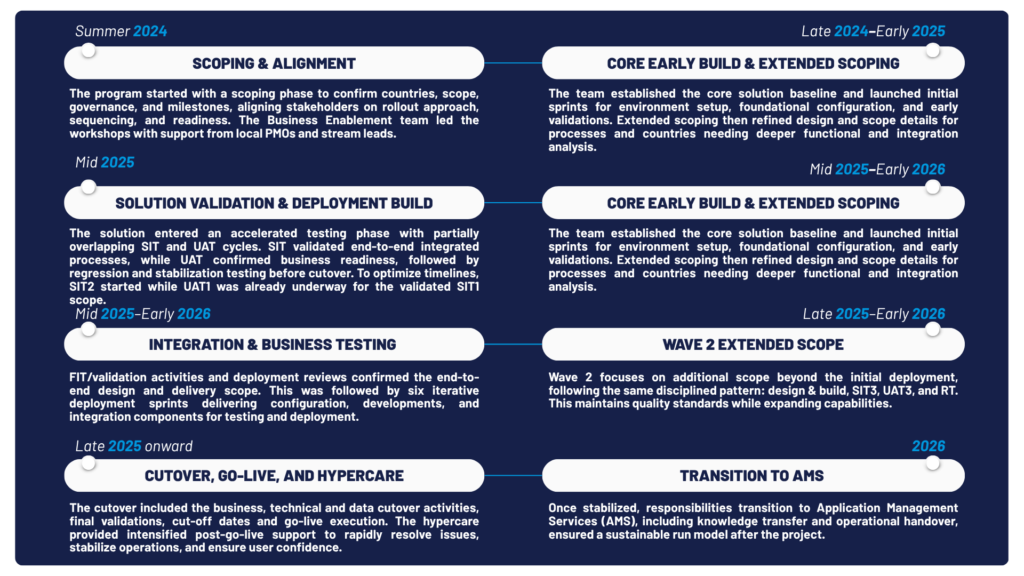
Throughout the full project lifecycle, readiness was embedded at every stage. Data readiness activities ran in parallel through mock cycles, data cleansing, and PRD readiness. People readiness included localization and derivations, training programs, process showcases, familiarization phases, key-user network activation, end-user training, and value realization measurement to support adoption and successful outcomes.
TECHNICAL REQUIREMENTS
The technical dimension required close attention to system readiness, integration, data quality, process continuity, and support models. This included:
- Alignment of system configuration with business requirements
- Validation of process flows and cross-functional dependencies
- Testing readiness across impacted scenarios
- Cutover sequencing and deployment control
- Post-go-live incident management and stabilization support
- Ensure interconnectivity of SAP S/4HANA with 60+ partner applications
The technical requirements were approached not as isolated tasks, but as part of a broader business transformation effort.
04. RISK ASSESSMENT & MITIGATION
The project carried several significant risks, typical of regional transformation initiatives with compressed timelines
RISKS INVOLVED
| Delays caused by cross-functional dependencies | Resource constraints during critical project phases |
| Misalignment between business expectations and technical readiness | Limited time for validation and issue resolution |
| Incomplete readiness for cutover or go-live | Business disruption during transition periods |
| Data or process quality issues affecting operations | A critical timeline where delays could result in financial penalties and loss of government contracts. |
HOW RISKS WERE MANAGED
Risks were addressed through proactive governance and close project control. TeamWork implemented:
- Regular tracking of critical actions and dependencies
- Structured escalation for blockers and decision points
- Clear ownership across workstreams
- Continuous communication between business and technical teams
- Readiness checkpoints before key milestones
- Focused support during cutover and hypercare phases
- Reassessing go-live dates when needed, to confirm whether risks could be mitigated through workarounds or whether the go-live should be adjusted
This risk-based approach enabled the team to anticipate issues early, respond quickly, and maintain project momentum even under pressure.
05. TIMELINE& DEPLOYMENT PHASE
Throughout the project, timeline decisions were continuously reassessed to mitigate high-risk topics and protect delivery quality. The original go-live planned for October 2025 for all countries was first postponed to early 2026 for the full scope. Later, due to the complexity of several finance and operational related topics, a two-wave deployment strategy was adopted, with countries segmented according to market value. This resulted in a first go-live for the priority markets in January 2026, followed by a second go-live for the remaining countries in February 2026.
As the same core teams remained responsible for the full scope, this shift required strong mitigation actions and careful team reorganization, especially during January, when they were simultaneously managing hypercare support for the first wave and executing cutover activities for the remaining countries.
06. RESULTS & BUSINESS BENEFITS
Our client’s LATAM project delivered substantial value for both the client and TeamWork.
OUR CLIENT
The implementation created a stronger digital foundation by centralizing business data within a single SAP platform, enabling faster analytics and more informed, data-driven decisions. The project also simplified and improved operations through greater harmonization, automation, and standardization of processes, while ensuring alignment with the client’s Group rules, regulatory expectations, and implementation best practices. As a result, the organization benefited from increased process consistency, enhanced digital enablement, and an improved user experience across the system.
TEAMWORK
The project reinforced its credibility and visibility as a trusted partner within our client’s Group. Building on successful collaborations across North America, the LATAM deployment expanded TeamWork’s presence across the Americas and demonstrated its ability to support complex, multi-country transformation programs. By helping the client achieve its objectives while maintaining a structured and value-driven delivery approach, TeamWork further strengthened its reputation as a reliable, long-term partner capable of delivering strategic impact across regions.
LEARN MORE ABOUT
SAP Business Solution
Our SAP specialists translate the operating model into a fully configured quality system integrating Instrument records, automated workflows, calibration scheduling, and document management into one auditable, scalable platform.

Management Consulting
Helping your organizations evolve
Discover Tomorrow by TW, our consulting firm dedicated to improving your organization’s performance.