– Written by Nguyen Pham Quang Viet
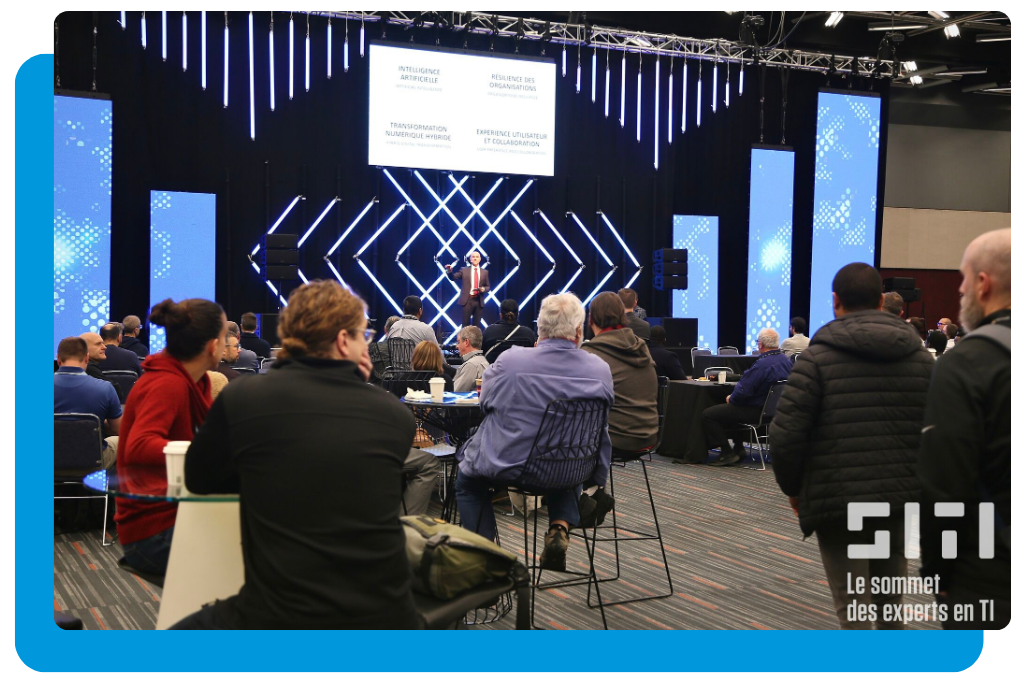
A look back at a day at SITI 2025, surrounded by the buzz of innovation and the quiet intensity of those who know that artificial intelligence is not just transforming technology — it is redefining how we think about expertise, trust, and control.
It wasn’t a conference about tools or algorithms. It was about balance. Between speed and safety, automation and accountability, machines that can think — and humans who must still decide.
The morning began with a discussion that perfectly captured the messy enthusiasm of today’s AI adoption. Many organizations, someone said, don’t plan their AI strategy — they stumble into it. Departments test copilots, small pilots bloom everywhere, and suddenly an enterprise finds itself with a dozen disconnected experiments and no single direction.
It’s striking. This isn’t a lack of vision; it’s a lack of coordination.
Everyone wants to innovate, but few are willing to pause and define what success truly means. Leaders fear that this process will slow progress, while technical teams worry that bureaucracy will stifle creativity.
The result? Fragmentation disguised as innovation.
By listening, we understand that governance is not a brake — it’s a steering wheel.
When a company invests early in alignment — defining its values, ethics, and risk tolerance — it doesn’t lose speed; it gains clarity. Well-designed governance doesn’t constrain; it guides.
Later that afternoon, a session from Palo Alto Networks added a more sobering note. Nearly eight out of ten enterprises already use AI in production, yet fewer than three in ten have ever conducted an AI risk assessment.
This paradox is striking.
We adopt AI faster than we secure it.
AI doesn’t just add a new layer of software; it transforms the entire risk landscape. Data flows unpredictably. Users can be manipulated. Models can be fooled into revealing what they shouldn’t.
And as we listen, one question arises: how do you secure something that learns faster than we can audit it?
The takeaway was clear: AI security must begin before the first model goes live. Test it in isolation. Observe its behavior. Understand what it can expose. And above all, keep a human in the loop for critical decisions. The goal is not to cage innovation, but to build safety into its very design — a delicate balance between agility and assurance.
Amid all the technical sessions, a quieter truth kept resurfacing: AI will never replace human judgment.
It can scan terabytes of logs and identify anomalies in milliseconds — but it doesn’t understand why something matters. It can’t sense hesitation in a choice, or doubt in a pattern. pas pourquoi quelque chose est important. Elle ne perçoit pas l’hésitation dans un choix ni le doute dans un schéma.
Context, empathy, and intent remain human territory.
To thrive in this era, experts must evolve — not to compete with AI, but to complement it. Precision becomes a discipline; curiosity becomes a safeguard.
The best defenders will not just understand how AI behaves, but how it misbehaves — how it can be manipulated, or how it can make assumptions. The future of cybersecurity will belong to those who pair logic with ethics, data with discernment, and speed with conscience.
As the day drew on, a debate around trust sparked lively discussion.
If even the AI pioneers admit we can’t fully rely on AI’s output, how can we entrust it with defending our systems?
One possible answer is coexistence.
We don’t need blind trust — we need continuous validation. Machines can detect and react at machine speed, but humans still need to interpret the meaning. Some call this hybrid model inefficient. On the contrary, it can be seen as necessary redundancy. In cybersecurity, duplication is not waste; it’s resilience.

The final panels looked toward what’s next — the dawn of what Cisco called the Agentic AI Era.
These are no longer copilots or assistants, but autonomous systems capable of reasoning, planning, and collaborating with other AI agents. Built across hybrid infrastructures — from NVIDIA GPUs to Kubernetes clusters — they represent not just evolution, but escalation.
And yet, amidst these technical marvels, one can’t help but reflect on what AI has already achieved.
Code that writes itself.
Systems that detect ransomware before it spreads.
Tools that give vision and voice to those who were previously without.
These aren’t threats to human work — they’re extensions of it.
AI won’t replace curiosity or empathy; it will replace repetition. That isn’t loss. That’s liberation.
Leaving SITI 2025, it’s natural to feel both inspired and concerned. AI can detect, decide, and even defend — but it still cannot be held accountable. That responsibility remains ours.
The challenge ahead isn’t whether machines can think, but whether we can guide them wisely.
Governance, transparency, and ethics are not accessories; they are the foundations of intelligent progress.
The future will belong to those who move fast and think deeply — to those who use AI not as a replacement for human intelligence, but as a partner that amplifies it.
AI can protect, predict, and perform — but only humans can ensure it does so with purpose.